

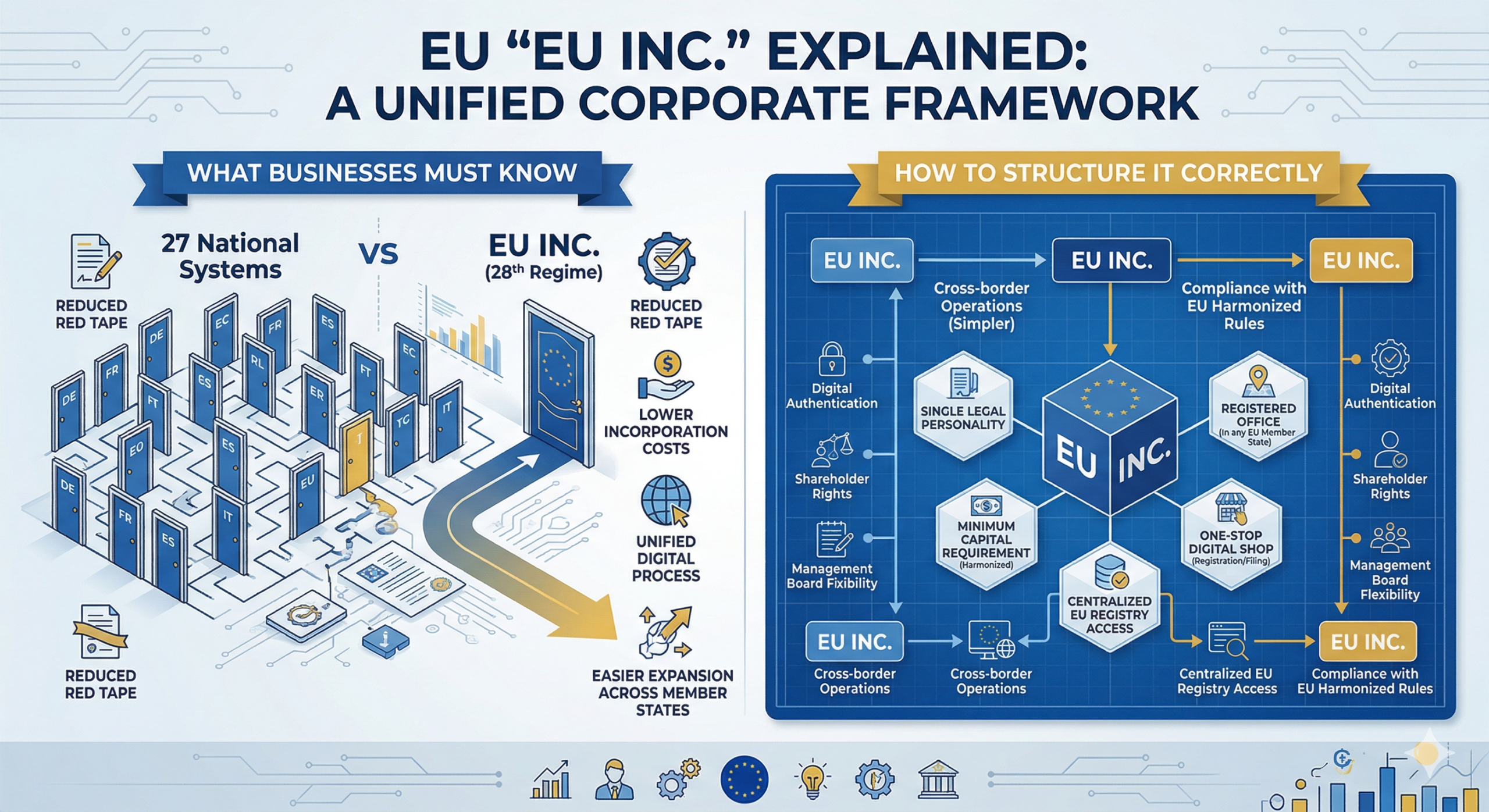
The European Commission has introduced a landmark proposal that could redefine how companies operate across Europe: the creation of a unified EU company framework, widely referred to as “EU Inc.” or the “28th regime.”
While the headlines focus on speed and simplicity, the reality is more nuanced—and for businesses operating in or entering the EU, getting the structure right will be critical.
At our firm, we view this development not simply as a regulatory change, but as a strategic opportunity for businesses that are properly advised from the outset.
What is “EU Inc.”?
The “EU Inc.” proposal introduces a new, optional legal regime that would allow companies to:
– Incorporate once and operate across all EU Member States
– Complete the process digitally, potentially within 48 hours
– Use a standardised corporate structure recognised EU-wide
This regime will exist alongside national systems (such as Cyprus limited companies), meaning businesses will have a choice of structure, rather than a one-size-fits-all solution.
The Key Misconception
Many assume that “EU Inc.” will eliminate the need for national companies.
This is incorrect.
“EU Inc.” does not replace:
– Tax residency rules
– Substance requirements (offices, employees, management)
– Licensing and regulatory obligations (e.g. CySEC, financial services, recruitment licensing)
In practice, this means:
Incorporation may become easier—but compliance, structuring, and regulatory positioning become more important than ever.
Why This Matters for Your Business
The introduction of “EU Inc.” creates new strategic decisions for any business operating in Europe:
1. Which structure should you choose?
– EU Inc.
– Cyprus company
– Multi-entity structure
– Hybrid model
Each option has different implications for:
– Tax exposure
– Regulatory obligations
– Operational flexibility
2. Where will your business be “based”?
Even with an EU-wide entity, businesses must still determine:
– Where management and control is exercised
– Where employees and operations are located
– Where tax residency is established
This is where jurisdictions like Cyprus remain highly relevant.
3. How will you remain compliant?
A simplified incorporation process does not mean simplified compliance.
Businesses will still need:
– AML and KYC frameworks
– Internal policies and procedures
– Ongoing regulatory monitoring
– Risk management systems
Why Cyprus Still Matters
Despite the introduction of “EU Inc.”, Cyprus continues to offer significant advantages:
– Established legal and corporate infrastructure
– EU-compliant tax framework
– Strategic position for international operations
– Access to regulated markets and licensing regimes
In many cases, the optimal solution will not be EU Inc. vs Cyprus, but rather:
EU Inc. combined with a Cyprus-based operational and compliance structure
How We Help
This is where professional guidance becomes essential.
At our firm, we assist clients in navigating this new landscape by providing end-to-end structuring and compliance solutions, including:
Strategic Structuring
– EU Inc. vs national entity analysis
– Cross-border corporate structuring
– Tax-aware legal frameworks
Compliance & AML
– Full AML/KYC framework setup
– Ongoing compliance officer services
– Risk assessments and internal controls
Substance & Operational Setup
– Establishing real presence in Cyprus
– Director and governance structuring
– Office and operational support
Licensing & Regulatory Advisory
– CySEC-regulated entities
– Recruitment and corporate licensing
– Fintech and payment institution advisory
The Strategic Advantage
The businesses that will benefit most from “EU Inc.” are not those who simply incorporate quickly—but those who:
– Choose the right structure from day one
– Align legal, tax, and operational elements
– Ensure full compliance across jurisdictions
Conclusion
“EU Inc.” represents a major step toward a more unified European business environment. However, it does not remove complexity—it redefines where the complexity lies.
For businesses, this is a moment to act strategically.
For advisors, it is a shift toward higher-value, integrated services.
At our firm, we position our clients at the forefront of these developments—ensuring they are not only compliant, but optimally structured for growth across the European Union.
If you are considering expanding or structuring your business within the EU, we invite you to contact us for tailored advice.